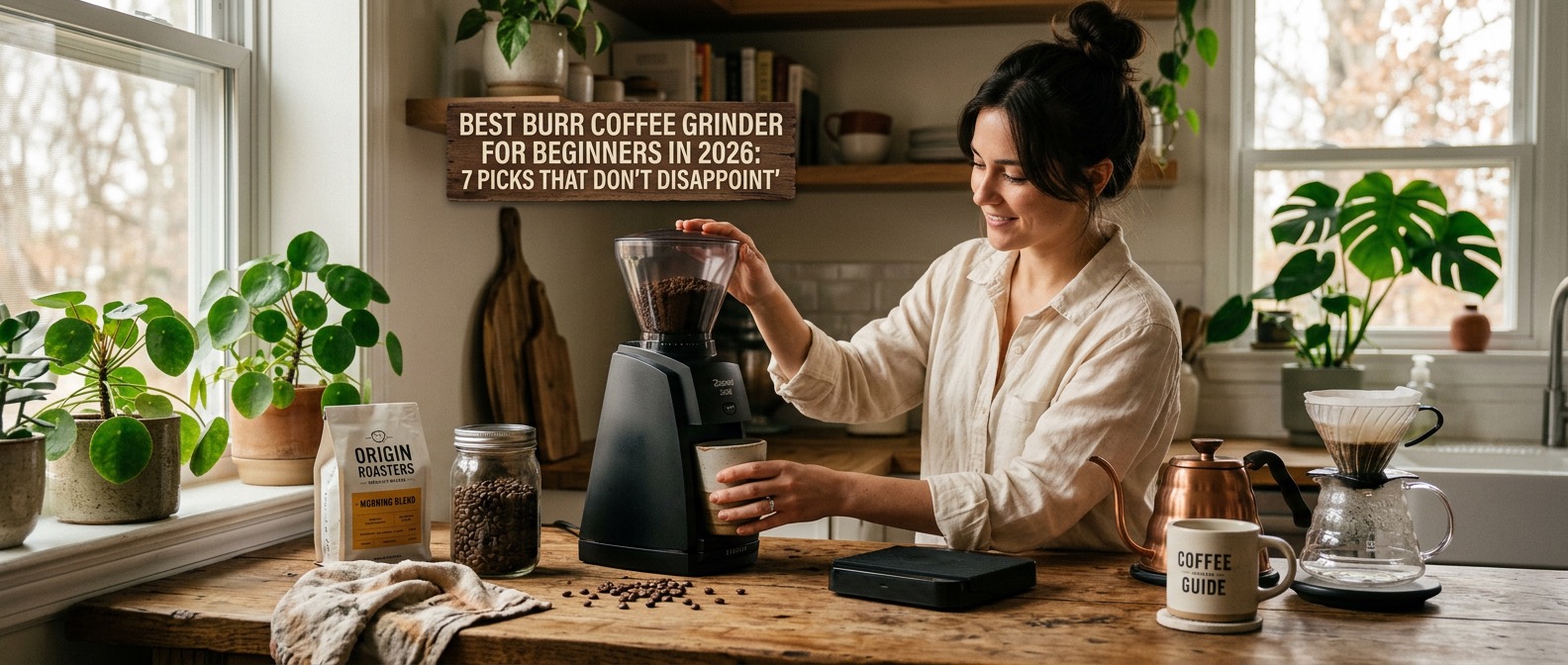
The grinder is the most impactful upgrade most coffee drinkers can make. A $200 espresso machine with freshly ground coffee outperforms a $500 machine using pre-ground beans from a bag that’s been open for three weeks.
Most coffee gear guides bury this. This one leads with it: if you’re choosing between a better machine and a better grinder, buy the grinder first.
This guide focuses on burr grinders specifically—the type that actually produces consistent ground size—for people buying their first one.
Blade vs. Burr: Why It Matters
A blade grinder (the kind with a spinning blade, like a small blender) chops coffee randomly. One pass produces a mix of fine powder and large chunks. That inconsistency means different particles extract at different rates—the fine powder over-extracts and tastes bitter; the large chunks under-extract and taste sour. You get both in every cup.
A burr grinder uses two abrasive surfaces (ceramic or steel) to grind coffee to a consistent size. The gap between the burrs determines the grind size. You get uniform particles, which means uniform extraction, which means better-tasting coffee.
Burr grinders cost more. They’re worth it.
The 7 Best Burr Coffee Grinders for Beginners
1. Baratza Encore — Best Electric Burr Grinder Overall
The Encore is the grinder most baristas and coffee professionals recommend to people getting started, and has been for over a decade. Forty grind settings cover everything from coarse French press to medium drip to fine espresso-adjacent (though a dedicated espresso grinder is better for pulling shots).
Key specs:
- Burrs: 40mm conical steel
- Grind settings: 40
- Motor: DC, front-mounted pulse button
- Bean hopper: 8 oz
- Dimensions: 6” W × 10” H
The build is durable enough that many Encores see 5–10 years of daily use with simple cleaning. Replacement parts are available directly from Baratza—not common for consumer grinders.
The Encore won’t win on aesthetics—it’s utilitarian. But grind consistency at this price point beats grinders that cost twice as much and prioritize looks.
2. OXO Brew Conical Burr Grinder — Best for Ease of Use
The OXO trades some of the Encore’s precision for a more intuitive interface. A single dial controls grind size; settings are numbered and labeled with suggested brew methods (French press, drip, espresso). For someone who doesn’t want to research what “setting 18” means, that’s genuinely useful.
Key specs:
- Burrs: 40mm conical steel
- Grind settings: 15 settings with micro-steps
- One-touch timer: Programmable for dose consistency
- Bean hopper: 12 oz (UV-blocking lid)
The UV-blocking hopper is a small but real advantage—light degrades coffee faster than most people realize. The OXO’s one-touch timer produces the same dose every time, which removes guesswork from morning brewing.
Slightly less grind setting range than the Encore, but sufficient for drip, French press, and pour over.
3. Hario Skerton Pro — Best Manual Grinder
If you travel, camp, or just want excellent coffee without spending $100+, the Hario Skerton Pro is the manual hand grinder to buy. Japanese engineering, ceramic burrs that don’t transfer heat to the grounds during grinding, and a stabilized grinding mechanism (the original Skerton had wobbly lower burrs—the Pro fixes this).
Key specs:
- Burrs: Ceramic conical
- Capacity: 100g beans
- Grind range: Espresso to coarse
- Weight: 0.77 lbs
Manual grinding takes 2–3 minutes per dose. That’s either meditative or annoying depending on how you feel about mornings. For pour over and French press, the result is excellent. For espresso, the grind is more consistent than the price suggests.
4. Capresso Infinity Conical Burr Grinder — Best Budget Electric Under $70
The Capresso Infinity is what you buy when $150 for a Baratza Encore isn’t in the budget right now. Conical steel burrs (16 settings), solid plastic construction, and quiet motor. Not as precise as the Encore but a significant step above any blade grinder.
Key specs:
- Burrs: Commercial-grade conical steel
- Grind settings: 16 (4 categories × 4 steps)
- Slowest RPM of any electric here (fewer static grounds)
- Bean hopper: 8.8 oz
The low RPM (450 rpm) is genuinely useful—slower grinding generates less static and less heat, both of which preserve flavor. Many more expensive grinders spin faster and produce more static.
Good for drip, French press, and pour over. Espresso is possible but inconsistent.
5. Fellow Opus — Best for Espresso at Entry Level
Most grinders under $100 can’t grind fine enough for real espresso with consistent particle size. The Fellow Opus can. Forty-one grind settings, with micro-adjustments at the finer end that matter for espresso. Also covers coarse French press on the other end—it’s a genuinely all-purpose grinder.
Key specs:
- Burrs: 40mm conical steel
- Grind settings: 41 + micro-adjustment
- Motor: Powerful DC, fast grinding
- Magnetic catch cup: Anti-static coating
The Opus is newer to the market than the Encore and slightly more expensive ($195), but its espresso capability is meaningfully better. If espresso is your primary use, this is the starting point.
6. JavaPresse Manual Coffee Grinder — Best Budget Hand Grinder
For anyone who wants to try a hand grinder before committing to a Hario, the JavaPresse costs $25–$35 and covers the basics. Ceramic burrs, 18 grind settings, and a compact enough form factor for travel. The conical mill is inconsistent at the finest settings, but for pour over and drip it’s more than adequate.
Not a forever grinder—the Hario Skerton Pro or a Timemore is the upgrade path—but a low-risk way to decide if hand grinding works for your routine.
7. Breville Smart Grinder Pro — Best Mid-Range Pick ($150-Range)
The Smart Grinder Pro sits between the Encore (precision, simplicity) and a full prosumer grinder (overkill for most). Sixty grind settings, programmable dosing by time or bean weight, and a display that shows exactly what you set. The stainless steel burrs are durable and easy to clean.
Key specs:
- Burrs: 40mm hardened stainless steel
- Grind settings: 60
- Dose control: Programmable
- Compatible: Portafilter cradle included
If you have a Breville espresso machine, the portafilter cradle grounds directly into it—a genuine convenience. The ecosystem integration is well thought-out.
Comparison at a Glance
| Grinder | Type | Burr Size | Espresso? | Price Range |
|---|---|---|---|---|
| Baratza Encore | Electric | 40mm conical | No (drip, press) | $140–$160 |
| OXO Brew | Electric | 40mm conical | No | $100–$120 |
| Hario Skerton Pro | Manual | Ceramic conical | Yes (with effort) | $50–$65 |
| Capresso Infinity | Electric | Steel conical | No | $55–$75 |
| Fellow Opus | Electric | 40mm conical | Yes | $185–$210 |
| JavaPresse | Manual | Ceramic | No | $25–$35 |
| Breville Smart Grinder | Electric | 40mm steel | Yes | $150–$180 |
What “Grind Size” Actually Means
Each brew method needs a different grind size because contact time with water varies:
- Espresso: Extra fine — 20–30 seconds contact time, high pressure
- Moka pot: Fine — similar to espresso, 4–5 minutes
- Pour over (V60, Chemex): Medium-fine — 3–4 minutes
- Drip coffee maker: Medium — 5–6 minutes
- French press: Coarse — 4 minutes, no paper filter
- Cold brew: Extra coarse — 12–24 hours steeping
Using the wrong grind size for your method is the most common reason homemade coffee tastes wrong. Too fine = over-extracted, bitter. Too coarse = under-extracted, sour and weak.
Ceramic vs. Steel Burrs
Ceramic burrs stay sharper longer and generate less heat during grinding (heat degrades flavor). Steel burrs are more durable and can be set more precisely.
For most home use, the difference is minimal. What matters more: burr size (larger = more consistent), RPM (lower = less heat, less static), and number of grind settings.
How to Clean a Burr Grinder
Once a week: knock loose grounds out of the chamber, brush visible surfaces with the included brush.
Once a month: run 20–30 grams of rice or grinder cleaning pellets (Grindz is the standard) through the machine at medium grind. This absorbs oils and clears buildup from the burrs. Follow with a pass of coffee to remove any rice residue.
Twice a year: disassemble the burr chamber and clean directly. Every grinder has a slightly different process—check the manual, but it’s always straightforward.
The Bottom Line
For most beginners buying their first burr grinder, the Baratza Encore is the right choice. It’s reliable, it lasts, it’s repairable, and the grind consistency makes every brew method noticeably better. If your budget stops at $70, the Capresso Infinity gets you 80% of the way there.
For espresso, the Fellow Opus is the entry point for a grinder that actually handles fine grinding well. And if you want to try the grinder experience without committing money to electricity, the Hario Skerton Pro is a quality manual option that travels anywhere.
Related: Best Espresso Machine Under $200 · How to Make Pour Over Coffee: Complete Guide
Editorial
The coffeegare team tests and reviews coffee gear to help you brew better coffee at home. Every recommendation is based on real use, not spec sheets.