Breville and De’Longhi are the two brands most people end up choosing between when buying a home espresso machine. They dominate different price points, target different users, and reflect genuinely different philosophies about what home espresso should be.
This isn’t a single head-to-head—it’s a brand comparison across the full price spectrum, from entry-level to prosumer. Because the right answer depends entirely on what you want from espresso.
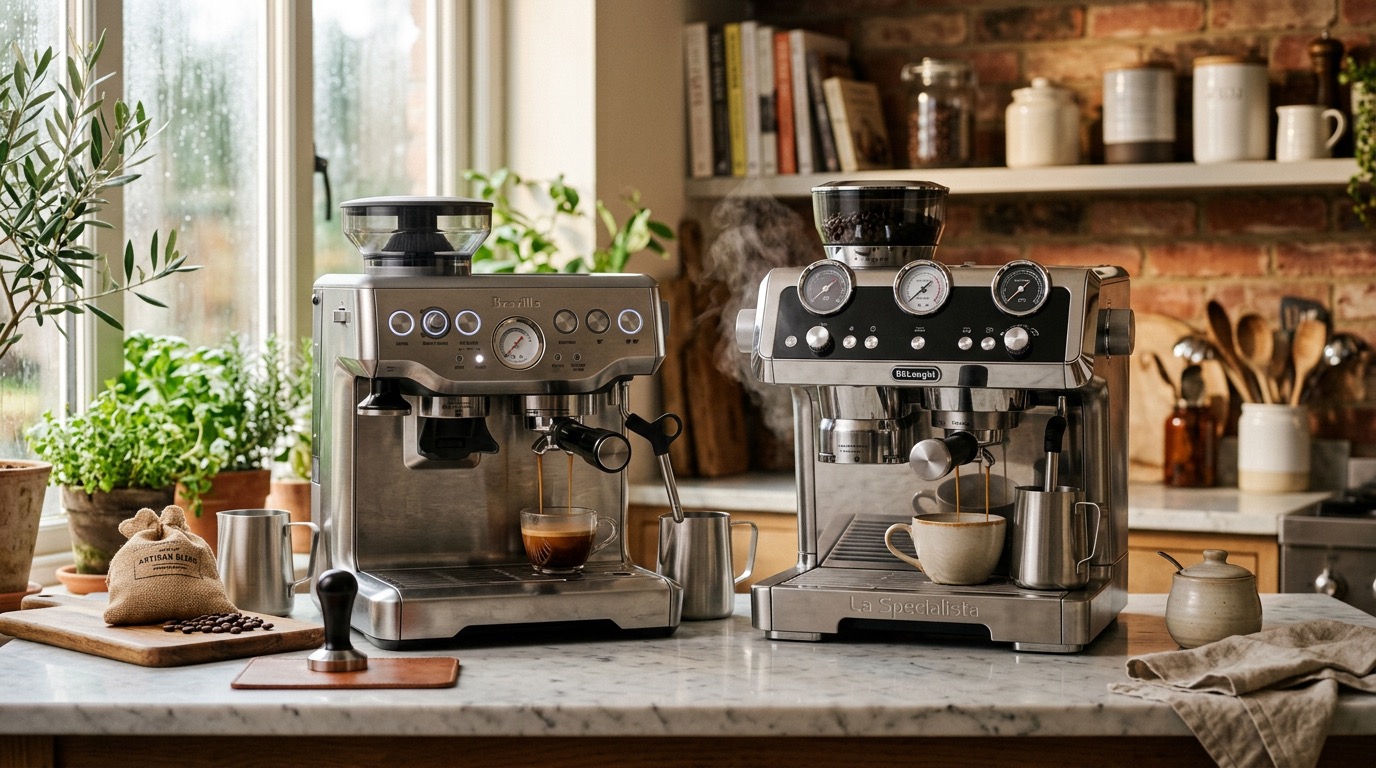
Choose Breville if: You want to develop barista skills, have control over every extraction variable, and plan to upgrade within the Breville ecosystem over time.
Choose De’Longhi if: You want excellent espresso with less involvement, prefer integrated solutions (built-in grinders, milk systems), or are buying at the entry level.
The Short Version
Breville: Precision and Control
Breville’s machines are built around the idea that you want to make great espresso and are willing to learn to do it. Their entry-level machines include pressure gauges. Their mid-range machines have shot timers. Their high-end machines have PID temperature control and pressure profiling.
They build a tight ecosystem—portafilters are 54mm across most models, grinder compatibility is consistent, and you can upgrade machines without replacing all your accessories.
Breville’s home market: Australia and North America. Their machines are designed with English-speaking home baristas in mind—documentation is excellent, the community is massive, and YouTube tutorials exist for every model.
De’Longhi: Integration and Convenience
De’Longhi has been making espresso machines in Italy since 1902. Their strength is integration: they make some of the most fully-automated machines available, with built-in grinders, milk systems, and one-touch drink programs. Their entry-level machines are forgiving of user error.
Their flagship La Specialista and Dedica lines bridge the gap between automatic convenience and manual control. But the design priority is different—De’Longhi makes machines for people who want espresso, not people who want to make espresso.
Brand Philosophy
Entry Level ($100–$200)
Breville Bambino ($200) vs De’Longhi EC155M ($80)
These machines aren’t really at the same price, which tells you something about each brand’s entry strategy.
De’Longhi EC155M:
- 15-bar pump, effective 9-bar extraction
- Manual steam wand (requires technique)
- Proprietary 51mm portafilter
- Durable, reliable, ~$80
The EC155M has been the default recommendation for entry-level espresso for a decade. It makes real espresso, the steam wand works, and it lasts. The downside: proprietary portafilter size limits accessory options.
Breville Bambino:
- Thermojet heating: 3-second heat-up
- Auto steam wand (easier for beginners)
- 54mm portafilter (wide accessory ecosystem)
- ~$200, but frequently on sale at $170
The Bambino is the better machine. The question is whether “better” is worth $120 more. For beginners still deciding if they like espresso: start with the De’Longhi. For someone committed to the hobby: the Bambino is the smarter long-term investment.
Winner at this tier: De’Longhi on value; Breville on quality.
De’Longhi EC155M on Amazon →
Breville Bambino on Amazon →
Mid-Range ($200–$500)
Breville Bambino Plus ($300) vs De’Longhi Dedica Style EC685 ($170) and De’Longhi La Specialista Arte (~$400)
De’Longhi Dedica Style (EC685): The Dedica is slim (6 inches wide), looks great on a small counter, and produces genuinely good espresso. The thermoblock system heats quickly. The 51mm portafilter is proprietary, which is the ongoing De’Longhi limitation.
At $170, it’s the best-looking entry-level machine available. Coffee quality is solid. Portafilter ecosystem is the tradeoff.
Breville Bambino Plus (~$300): Everything the Bambino has, plus an auto-purging steam wand that sets milk temperature automatically and a hands-free frothing mode. You tell it the temperature and texture you want; it handles the technique.
At $300 it’s the best automatic steam wand available under $500. For latte drinkers who want consistent milk drinks without learning to steam manually, it’s the clear choice.
De’Longhi La Specialista Arte (~$400): The first De’Longhi machine with a built-in grinder and “sensor grinding technology” that adjusts dose automatically. One machine, one counter footprint, espresso to cup without a separate grinder.
The grinder quality is the question—built-in grinders at this price are always a compromise versus a dedicated burr grinder. But for a complete, clean setup, nothing else delivers it at this price.
Winner at this tier: Breville Bambino Plus for espresso quality; De’Longhi La Specialista Arte for all-in-one convenience.
Breville Bambino Plus on Amazon →
De’Longhi La Specialista Arte on Amazon →
Premium ($500–$1,000)
Breville Barista Express ($600) vs De’Longhi La Specialista Prestigio ($750)
Breville Barista Express: The Barista Express is where Breville’s ecosystem becomes compelling. Integrated conical burr grinder, 54mm portafilter, PID temperature control, manual microfoam steam wand, and a full pressure gauge. It’s the most popular prosumer espresso machine in its class.
The grinder is good—not as good as a standalone $200 grinder, but consistently good enough that most users never feel the need to upgrade. The machine grows with your skills: you can adjust dose, grind size, temperature, and pressure all independently.
De’Longhi La Specialista Prestigio: De’Longhi’s answer to the Barista Express. Similar concept: built-in grinder, tamper, full extraction controls. The Prestigio adds a hot water spout for americanos and a more refined milk steam system.
The design is distinctly Italian and premium-feeling. The espresso quality is comparable to the Barista Express. The community and documentation around it are thinner—if you’re the type to watch YouTube tutorials and dive deep into dialing in espresso, Breville wins by having a larger ecosystem of guides and mods.
Winner at this tier: Breville Barista Express on ecosystem and community; De’Longhi Prestigio on aesthetics and integrated features.
Breville Barista Express on Amazon →
De’Longhi La Specialista Prestigio on Amazon →
Super-Automatic / Prosumer ($1,000+)
De’Longhi Eletta Explore vs Breville Oracle Touch
This tier is where De’Longhi leads clearly.
De’Longhi Eletta Explore (~$1,000): Full super-automatic: bean-to-cup with one touch. Grinds, doses, tamps, extracts, and froths milk automatically. Over-ice cold brew mode. Cold extract function. 17 drink recipes from a touchscreen. Zero barista skills required.
If you want café-quality drinks at home with no learning curve and no manual steps, De’Longhi’s super-automatics are the answer.
Breville Oracle Touch (~$2,000): Breville’s attempt at full automation. It automates every step but maintains manual controls for enthusiasts who want them. The result is more complex—and more expensive.
The Oracle Touch is for serious espresso enthusiasts who want automation for convenience but don’t want to give up control. The De’Longhi Eletta is for people who want great coffee quickly.
Winner at this tier: De’Longhi for convenience; Breville Oracle Touch if budget isn’t a limit and you still want control.
De’Longhi Eletta Explore on Amazon →
Breville Oracle Touch on Amazon →
Head-to-Head by Price Tier
| Factor | Breville | De’Longhi |
|---|---|---|
| Portafilter standard | 54mm (mid), 58mm (premium) | 51mm (entry), 58mm (premium) |
| Design origin | Australia | Italy |
| Best strength | Espresso quality + control | Integration + convenience |
| Community/support | Very large | Moderate |
| Entry price | $200 (Bambino) | $80 (EC155M) |
| Super-automatics | Limited | Extensive |
| Ecosystem upgrades | Strong | Moderate |
Side-by-Side: Key Differences
You want to learn to make espresso properly → Breville
The ecosystem, community, and control features reward skill development. Start with the Bambino, upgrade to the Barista Express when ready.
You want espresso without the learning curve → De’Longhi
The EC155M is the best value entry machine. The La Specialista Arte is the best all-in-one under $500. The super-automatics are unmatched for convenience.
You’re buying as a gift for someone → De’Longhi
More forgiving of inexperience. Better aesthetic range. The Dedica especially looks like a premium gift without being intimidating.
You’re setting up for latte drinks → Breville Bambino Plus
The auto steam wand produces consistent milk texture with no technique required. Nothing else at the price level does this as well.
Related: Best Espresso Machine Under $200 · Breville Bambino vs Bambino Plus: Which Should You Buy?
Editorial
The coffeegare team tests and reviews coffee gear to help you brew better coffee at home. Every recommendation is based on real use, not spec sheets.