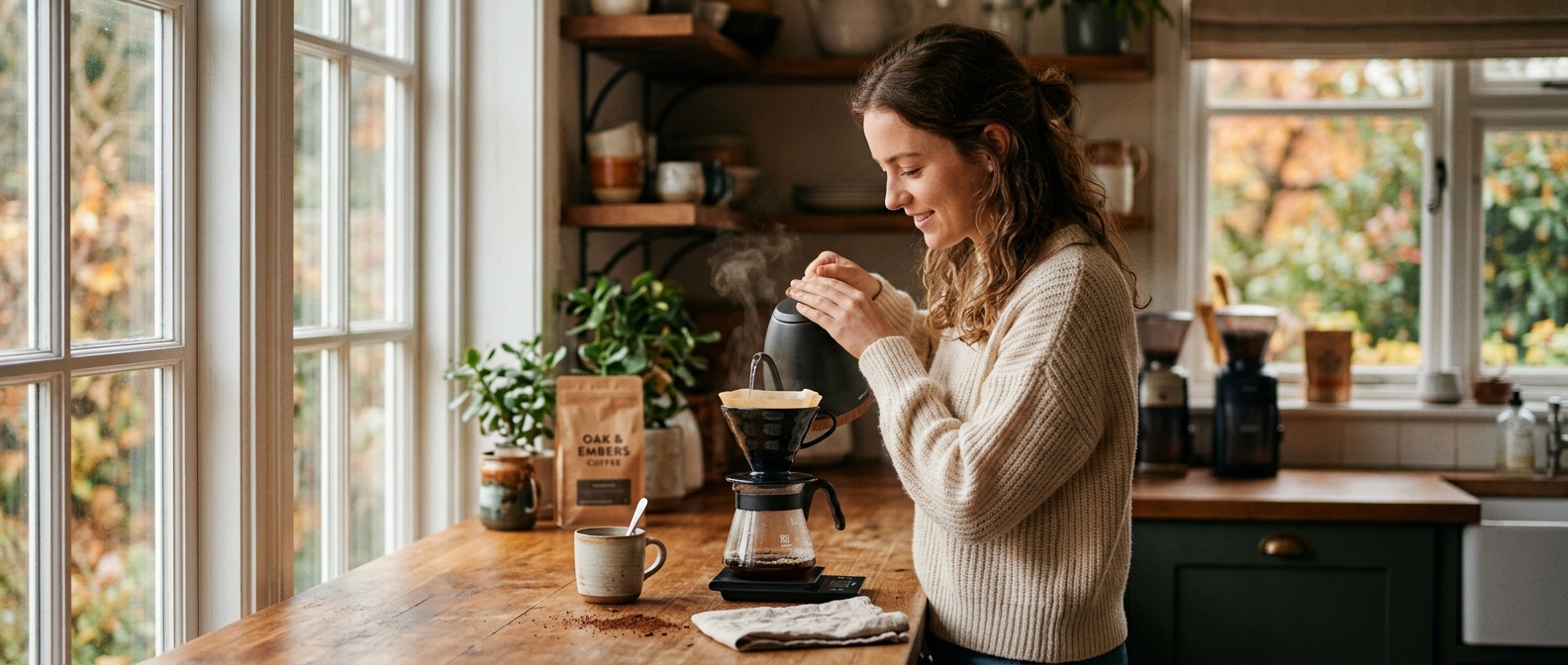
Pour over coffee is simple once you understand what’s happening. Hot water passes through ground coffee at a controlled rate, extracting flavor compounds as it goes. A paper filter catches the grounds and oils, leaving a clean, transparent cup where individual flavors—fruit, chocolate, florals—come through clearly.
It’s not complicated, but it requires attention. The equipment does nothing automatically. That’s the point.
This guide covers everything: what gear you actually need, how to grind correctly, the ratio to use, and the technique step by step.
What You Need (and What You Don’t)
Essential gear
A dripper: The V60 (Hario) and Chemex are the two most popular. The V60 produces a brighter, more dynamic cup. The Chemex uses a thicker filter that strips more oils, producing a cleaner, milder result. Either works. Start with one and stick with it until you understand what the variables do.
Hario V60 Plastic (02 size) on Amazon →
Chemex 6-Cup on Amazon →
Filters: Buy the filters made for your dripper. Hario V60 paper filters, Chemex pre-folded squares. Rinse them before use (more on this below).
A gooseneck kettle: The long, narrow spout gives you control over where water goes and how fast it flows. Standard kettles pour too fast and dump water unevenly across the grounds. An electric gooseneck with temperature control is the ideal; a stovetop version with a gooseneck spout works fine too.
Fellow Stagg EKG Electric Gooseneck Kettle on Amazon →
A burr grinder: Blade grinders produce inconsistent particle size, which means inconsistent extraction. A $50–$150 burr grinder is the most impactful purchase in coffee. The Baratza Encore is the standard recommendation.
A scale: Coffee recipes are measured by weight, not scoops. A kitchen scale that reads in grams is essential. A $10 scale from Amazon works fine.
A timer: Your phone works. You’re tracking total brew time.
What you don’t need
- A fancy ceramic dripper (plastic V60 produces identical results)
- A separate gooseneck pouring vessel (kettle does the job)
- Expensive specialty beans to start learning (use whatever you enjoy drinking)
The Ratio: How Much Coffee to Water
The standard ratio for pour over is 1:15 to 1:17 (coffee to water by weight).
- 1:15 = 20g coffee → 300g water (stronger)
- 1:16 = 20g coffee → 320g water (balanced)
- 1:17 = 20g coffee → 340g water (lighter)
Start with 1:16 and adjust from there. If your coffee tastes bitter, use less coffee or grind coarser. If it tastes sour and weak, use more coffee or grind finer.
For a standard V60 (02 size) that makes one cup: 20g coffee, 320g water.
Grind Size for Pour Over
Medium-fine. About the texture of rough table salt—coarser than espresso, finer than French press.
On a Baratza Encore: settings 14–20 depending on the bean. Start at 17 and adjust.
Consistent grind matters more than exact setting. If your brew is taking too long (>4 minutes), go coarser. If water runs through in under 2 minutes without much resistance, go finer.
Water Temperature
93°C / 200°F is the standard. Just off the boil (water boils at 100°C; letting it sit 30–45 seconds drops it to ~93°C).
Light roasts can handle slightly hotter water (95°C+) because they’re denser and need more energy to extract fully.
Dark roasts do better slightly cooler (88–91°C) because they’re more porous—hotter water over-extracts them quickly.
If you don’t have a temperature-controlled kettle, boil and wait 45 seconds.
Step-by-Step: V60 Pour Over
What you’re making
- 20g coffee, 320g water, target time: 3:00–3:30 total
Step 1: Set up and rinse
Place the V60 on your cup or carafe. Insert a paper filter. Wet it thoroughly with hot water—this removes the papery taste that unrinsed filters add to the cup, and it preheats the dripper.
Discard the rinse water from the cup.
Step 2: Add coffee
Weigh 20g of freshly ground coffee. Add it to the filter. Give the dripper a gentle shake to level the bed.
Place on your scale, tare to zero.
Step 3: Bloom pour (0:00 – 0:45)
Start your timer. Pour 40g of water—twice the weight of the coffee—evenly over the grounds. Start from the center and spiral outward.
The coffee will bubble and rise. This is CO₂ releasing from freshly roasted beans (called degassing or blooming). Wait 30–45 seconds. This lets the gas escape before brewing so it doesn’t create channeling (uneven water flow) in the main pour.
If there’s almost no bubbling, your coffee is stale. Fresh coffee blooms visibly.
Step 4: Main pour (0:45 – 2:30)
Pour the remaining 280g of water in slow, steady, circular pours. Don’t pour all at once—pour in intervals that keep the water level consistent without overflowing the filter.
Technique: Start from the center, spiral out to about 1cm from the filter edge, spiral back in. Slow and steady. Each pour should take 15–20 seconds. Rest between pours as the water drains slightly.
The goal is to keep the grounds agitated and evenly saturated throughout.
Step 5: Drawdown (2:30 – 3:30)
Stop pouring when you’ve added 320g total. Let the remaining water drain through the coffee bed. This should complete around the 3:00–3:30 mark.
When it finishes, the coffee bed should be relatively flat and even. An uneven bed (holes, piling on one side) indicates channeling—water found the easiest path and skipped other grounds. Adjust your pouring technique or grind size next time.
Step 6: Taste and adjust
This is where you learn. Taste the coffee before adding anything.
- Too bitter: Grind coarser, use cooler water, or brew faster (coarser grind)
- Too sour/weak: Grind finer, use hotter water, or slow down the pour
- Too strong overall: Use less coffee (try 18g) or more water
- Too weak overall: Use more coffee (try 22g)
Keep notes. Your ideal cup requires 2–4 iterations on the same beans.
Common Mistakes
Grinding too fine and clogging the filter
Water takes 5+ minutes to drain. The coffee over-extracts and tastes harsh. Go coarser.
Pouring too fast
Dumping water in one continuous stream agitates the grounds unevenly. Slow down. The gooseneck kettle exists to make this easier.
Skipping the rinse
Unrinsed paper filters add a noticeable papery taste. 10 seconds of rinsing with hot water before adding coffee prevents it.
Using hot-plate-kept coffee
If you brewed into a glass carafe sitting on a warmer, the coffee is slowly cooking. Pour it into a preheated thermal vessel immediately after brewing.
Using stale beans
Coffee peaks 7–21 days after roast. If the bag has no roast date, or the date is more than 6 weeks ago, the aromatics are mostly gone. The most expensive dripper in the world can’t fix stale coffee.
The Chemex: What’s Different
The Chemex uses a thicker filter (roughly 20–30% thicker than the V60’s) that absorbs more of the coffee oils. The result is a noticeably cleaner, less heavy cup—sometimes described as tea-like in clarity.
The technique is almost identical: same ratio, same water temperature, bloom pour first, then main pour in stages. The main difference is total brew time (4–5 minutes for a 6-cup Chemex vs. 3–3:30 for a single V60) and a slightly coarser grind to account for the longer contact time.
The Chemex is the right tool if you want to brew a larger batch (up to 6 cups) and want the cleanest possible cup. The V60 is better for single cups and for tasting nuanced single-origin beans clearly.
Choosing Beans for Pour Over
Pour over’s clean extraction makes it honest about bean quality—it doesn’t hide flaws, but it also showcases good beans better than any other method.
Light to medium roasts generally taste best: the paper filter removes the oils that make dark roasts taste bold in a French press, so what’s left is acidity and aroma. If you primarily drink dark-roast coffee, try medium roast in the pour over before giving up on it.
Single-origin beans (from one country or region) show off the most interesting flavors—Ethiopian Yirgacheffe produces floral and citrus notes; Colombian beans tend toward chocolate and caramel; Sumatran beans are earthy and full-bodied.
Fresh beans matter more than origin. A freshly roasted $12 bag from a local roaster will produce a better cup than a premium $20 bag that’s been sitting in a warehouse.
Quick Reference Card
| Variable | Standard Starting Point |
|---|---|
| Coffee | 20g |
| Water | 320g |
| Ratio | 1:16 |
| Grind | Medium-fine (table salt) |
| Water temp | 93°C / 200°F |
| Bloom | 40g, 30–45 sec |
| Total brew time | 3:00–3:30 |
Frequently Asked Questions
Do I need an expensive kettle?
A gooseneck spout matters; the price does not. A $25 stovetop gooseneck kettle produces the same cup as a $175 Fellow Stagg. The electric temperature control is convenient but not essential.
Can I use a regular kettle?
Technically yes, but controlling pour rate and direction is difficult. You’ll spill, you’ll pour unevenly, and your results will be inconsistent. If you’re serious about pour over, buy a gooseneck kettle.
How fine should I grind for Chemex vs V60?
Slightly coarser for Chemex (medium vs. medium-fine). The thicker filter slows water flow, so the contact time is already longer—grinding as fine as a V60 would over-extract.
What if my water drains in under 2 minutes?
Grind finer. The bed isn’t creating enough resistance.
Do I need filtered water?
Tap water that tastes fine to drink will produce fine coffee. Water with heavy chlorination or mineralization will change the flavor. If your tap water tastes off, use filtered—it makes a difference.
Pour over is a skill that improves with repetition. The first few cups will be okay. By the tenth brew on the same beans, you’ll understand exactly what you’re doing and why.
Related: Best Coffee Grinder for Pour Over · Best Coffee Beans for Iced Coffee
Editorial
The coffeegare team tests and reviews coffee gear to help you brew better coffee at home. Every recommendation is based on real use, not spec sheets.